Omega-3 foods: which oily fish count in the UK, and what plants really give
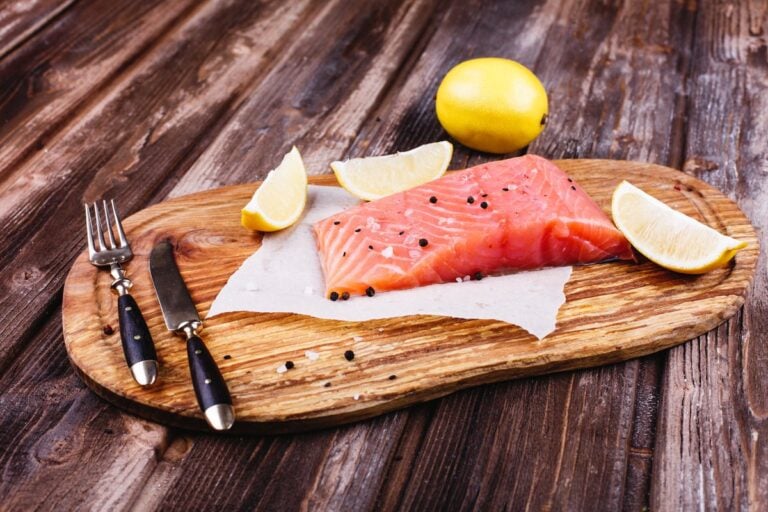
Omega-3 foods rich in EPA and DHA are oily fish: the NHS counts salmon, mackerel, sardines, herring, pilchards, sprats and trout, but not fresh or canned tuna. Flaxseed, chia and walnuts give only ALA, which barely raises DHA. The NHS advises at least 2 fish portions a week, including 1 oily; a portion is around 140 g cooked. UK adults 19 to 64 averaged 56 g oily fish a week in NDNS 2016/17 to 2018/19. On keto, oily fish fits with no carbs, and algal oil covers fish-free weeks.
Passionate about writing and a graduate in clinical dietetics. She is particularly interested in phytotherapy and the effects of ketogenic nutrition on cognitive brain function.
Which foods are high in omega-3? Foods high in omega-3 EPA and DHA are oily fish: the NHS lists herring, including kippers, pilchards, salmon, sardines, sprats, trout and mackerel [9]. The practical split is simple: EPA, DHA and ALA are all omega-3 fats, but the UK oily-fish list is about EPA and DHA, while plants such as flaxseed, chia, walnuts and rapeseed oil supply ALA [1]. Fish get EPA and DHA mainly from their diet, because microalgae and other marine microorganisms at the base of the marine food chain produce them [1]. Fish can produce EPA and DHA themselves only to a limited, species-dependent extent [1]. Tuna has EPA and DHA, but fresh and canned tuna do not count as oily fish in NHS advice [9].
Food
Omega-3 type
Counts as NHS oily fish
Mean mercury [mg/kg]
Salmon
EPA, DHA
yes
0.03
Trout
EPA, DHA
yes
0.03
Herring and kippers
EPA, DHA
yes
0.04
Mackerel
EPA, DHA
yes
0.11
Sardines and pilchards
EPA, DHA
yes
not given here
Sprats
EPA, DHA
yes
not given here
Tuna, fresh or canned
EPA, DHA
no
0.29
Flaxseed, chia seeds, walnuts
ALA
not fish
not applicable
Which fish is the best source of omega-3?
Which fish is the best source of omega-3? The best fish for omega-3 is any oily fish listed by the NHS, but the amount depends on what the fish ate [9]. In an RCT of 51 people eating salmon fed fish oil or rapeseed oil, salmon fed fish oil had 2.1 g EPA plus DHA per 100 g of fillet, salmon fed rapeseed oil had 0.9 g, and health benefits in eaters were not smaller in the rapeseed group [3]. In 1,108 farmed salmon samples from Norway, median EPA plus DHA fell by more than 60% between 2005 and 2020 as fish oil in feed was replaced by plant oils [2]. One 175 g portion of farmed salmon still covers an adult’s weekly adequate intake of EPA and DHA as set by EFSA [2]. For a wider keto view, see which fish to eat on keto.
Does tuna have omega-3?
Does tuna have omega-3? Tuna has some omega-3, but the NHS does not count fresh or canned tuna as oily fish [9]. Tuna also carries more mercury than oily fish: in EFSA data from over 12,000 results in 20 countries, the European mean was 0.29 mg/kg for tuna, against 0.03 mg/kg for salmon and trout [8]. The UK legal maximum for mercury in tuna is 1.0 mg/kg [11]. In the FSA retail survey 2025/26, 2 of 50 raw tuna samples exceeded it, while all 40 ready-to-eat tuna products complied [11]. If you are pregnant or trying for a baby, the NHS says you should have no more than 4 medium cans, about 140 g drained each, or 2 tuna steaks, 140 g cooked, a week [9]. There is no tuna limit when breastfeeding [9].
Did you know? COT’s December 2025 statement said the data did not provide a basis for revising COT 2003 health-based guidance values for methylmercury: 1.6 µg/kg a week in pregnancy and 3.3 µg/kg a week for other adults.
How much oily fish should you eat a week?
How much oily fish should you eat a week? The NHS advises at least 2 portions of fish a week, 1 of them oily, and a portion is around 140 g cooked [9]. SACN, whose 450 mg long-chain omega-3 a day is a population guideline, not a formal DRV, calculated that two portions of fish a week, one white and one oily, provide about that amount [10]. For the detail behind daily intake, see how much omega-3 per day. There is also an upper limit, because pollutants such as dioxins and PCBs can build up in the body [9]. The NHS says no more than 2 oily portions a week for girls, women who may become pregnant, pregnant women and breastfeeding women, and up to 4 for boys, while SACN (2004) puts the range for men at 1 to 4 portions a week [9][10]. UK adults aged 19 to 64 ate an average of 56 g of oily fish a week in NDNS Years 9 to 11 (2016/17 to 2018/19) [12].
Group
Oily fish portions a week
Portion [g, cooked]
Note
All adults (minimum)
at least 1 (within 2 fish portions)
140
most people in the UK eat less
Boys (NHS) and men (SACN 2004), maximum
up to 4
140
pollutants such as dioxins and PCBs build up
Girls, women who may become pregnant, pregnant or breastfeeding (maximum)
up to 2
140
same reason
UK adults 19 to 64, actual intake
56 g a week on average
not applicable
NDNS years 9 to 11
Planning your oily fish portions?
A tin of sardines or a fillet of smoked mackerel makes a quick lunch on keto bread. See the keto breads range in the BeKeto shop.
Which plant foods contain omega-3? Plant foods such as flaxseed, chia seeds, walnuts and rapeseed oil contain omega-3 as ALA, not EPA or DHA. The body converts little: in isotope studies, young women given 700 mg labelled ALA converted an estimated net 21% to EPA and 9% to DHA over 21 days, while in 6 young men EPA and DPA were formed but labelled DHA was not detected [4]. That is why claims about chia seeds and omega-3 can mislead if they compare ALA with fish EPA and DHA. ALA supplementation raises EPA in blood but has little effect on DHA [5]. In a review of 13 RCTs from 2010 to 2020, high-dose flaxseed or echium oil did not raise the omega-3 index, while microalgal oil raised it in every included study [5]. For fish-free EPA and DHA, read our guide to vegan omega-3.
Did you know? Microalgal oil raised EPA and DHA blood levels as effectively as fish oil in a 2025 randomised double-blind trial. The algal-oil producer ran it: five authors were employed by dsm-firmenich, the sixth a contracted statistician.
Can you get enough omega-3 from food on keto?
Can you get enough omega-3 from food on keto? You can get enough omega-3 from food on keto if oily fish is on the menu; a keto diet built on meat, dairy, nuts and plant oils gives far less EPA and DHA [6]. For food-first planning, see omega-3 on keto. We found no human trials of omega-3 supplements in adults on a ketogenic diet [6]. In UK Biobank, 117,108 people had an estimated mean omega-3 index of 5.58%, from plasma NMR rather than red blood cells, in the low range [7]. UK Biobank is not a representative sample, so that is not “the average UK omega-3 index” [7]. In the same analysis, oily fish and fish oil supplements were the strongest positive predictors of the omega-3 index, and oily fish accounted for 7.0% of the explained variation [7]. If food choices leave gaps, compare keto supplements that fit a keto diet, including algal oil.
What if you do not eat oily fish: how does BeKeto MEGA Omega compare?
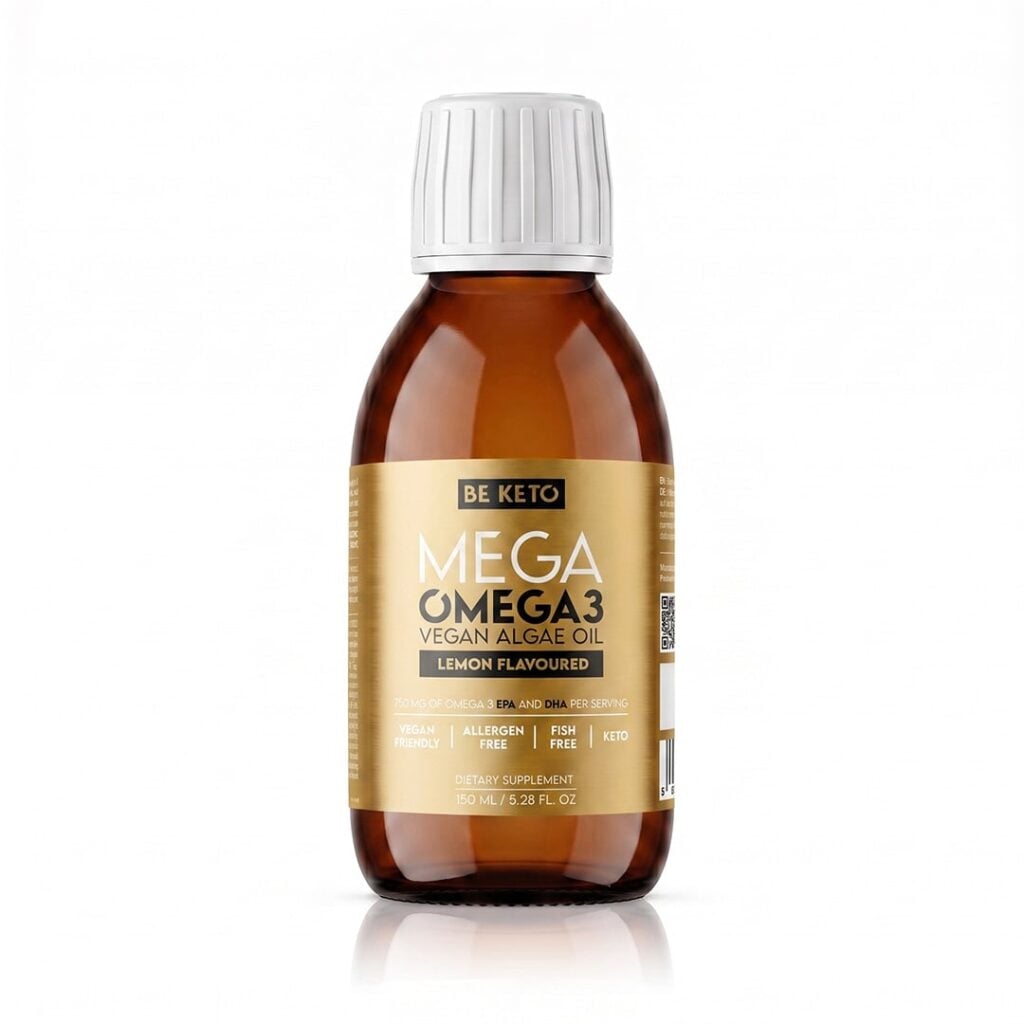
What if you do not eat oily fish: how does BeKeto MEGA Omega compare? For weeks without oily fish, MEGA Omega 3 vegan algae oil comes out best for keto eaters who avoid fish, because one 5 ml teaspoon gives 570 mg DHA and 185 mg EPA, above the SACN guideline of 450 mg long-chain omega-3 a day, from the same source fish rely on: microalgae [13][10][1]. It is Schizochytrium sp. microalgae oil, with Sicilian lemon flavour, and it is fish-free, free from allergens requiring declaration and vegan [13]. Use the recommended daily 5 ml serving straight from the spoon or in cold dishes; do not exceed it. “This product is intended for adults. Not for use by children or by women who are pregnant or breastfeeding. If you take anticoagulant medication or are due to have surgery, consult your doctor before use.” [13]
Oily fish not on your menu?
Flaxseed and walnuts provide ALA, not EPA or DHA. MEGA Omega 3 Vegan is a fish-free algae oil with 570 mg DHA and 185 mg EPA in 5 ml.
This product is intended for adults. Not for use by children or by women who are pregnant or breastfeeding. If you take anticoagulant medication or are due to have surgery, consult your doctor before use.
Frequently asked questions (FAQ)
What food has the highest omega-3?
What food has the highest omega-3? The food with the highest omega-3 EPA and DHA is oily fish such as salmon, mackerel and sardines [9]. In one RCT of 51 people eating salmon, fillets from salmon fed fish oil had 2.1 g EPA plus DHA per 100 g [3]. Seeds and nuts can be high in ALA, a different omega-3.
Do eggs have omega-3?
Do eggs have omega-3? Eggs have small amounts of omega-3, and the NHS does not count them towards oily fish [9]. Omega-3-enriched eggs depend on the hen’s feed; check the label for the amount of EPA and DHA in mg and compare it with the UK population guideline of 450 mg a day [10].
What fruit is high in omega-3?
What fruit is high in omega-3? No fruit is high in omega-3; fruit contains very little fat. Plant omega-3 comes from seeds and nuts as ALA, while EPA and DHA come from oily fish and microalgae [1]. Avocado is not an omega-3 food in the UK oily-fish sense used here.
Does cod have omega-3?
Does cod have omega-3? Cod contains some omega-3, but it is a white fish, not an oily fish [9]. SACN calculates that two fish portions a week, one white and one oily, contain about 450 mg long-chain omega-3 a day [10]. Cod liver oil is different: it also contains vitamins A and D.
Should you avoid any fish for mercury?
Should you avoid any fish for mercury? Shark, swordfish and marlin should not be eaten by anyone who is pregnant, trying for a baby, or under 16; other adults should eat no more than 1 portion a week [9]. Oily fish recommended for omega-3 carry 10 to 40 times less mercury than swordfish [8].
Discover more in the BeKeto keto shop
Besides supplements, the shop has keto vitamins, snacks and bread.
NHS, Fish and shellfish (reviewed 26.06.2026); NHS, Foods to avoid in pregnancy; SACN/COT 2004. nhs.uk/live-well/eat-well/food-types/fish-and-shellfish-nutrition/
SACN/COT, Advice on Fish Consumption, 2004. gov.uk/government/publications/sacn-advice-on-fish-consumption
A graduate in clinical dietetics whose interests begin, not end, with the word diet. She has written specialist content on nutrition. She is fascinated by contemporary food culture, phytotherapy and the effects of the ketogenic diet on cognitive brain function. She promotes diet therapy and the nutritional treatment of disease.
To provide the best experiences, we use technologies like cookies to store and/or access device information. Consenting to these technologies will allow us to process data such as browsing behaviour or unique IDs on this site. Not consenting or withdrawing consent, may adversely affect certain features and functions.
Functional
Always active
The technical storage or access is strictly necessary for the legitimate purpose of enabling the use of a specific service explicitly requested by the subscriber or user, or for the sole purpose of carrying out the transmission of a communication over an electronic communications network.
Preferences
The technical storage or access is necessary for the legitimate purpose of storing preferences that are not requested by the subscriber or user.
Statistics
The technical storage or access that is used exclusively for statistical purposes.Przechowywanie techniczne lub dostęp, który jest używany wyłącznie do anonimowych celów statystycznych. Bez wezwania do sądu, dobrowolnego podporządkowania się dostawcy usług internetowych lub dodatkowych zapisów od strony trzeciej, informacje przechowywane lub pobierane wyłącznie w tym celu zwykle nie mogą być wykorzystywane do identyfikacji użytkownika.
Marketing
The technical storage or access is required to create user profiles to send advertising, or to track the user on a website or across several websites for similar marketing purposes.


 United KingdomCurrent regionDelivery within the United KingdomCurrency: Pound Sterling (£)
 GermanyDelivery within Germany and AustriaCurrency: Euro (€)
 FranceDelivery within France and BelgiumCurrency: Euro (€)
 ItalyDelivery within ItalyCurrency: Euro (€)
 PolandDelivery within Poland and EuropeCurrency: Zloty (PLN)
 Czech RepublicDelivery within the Czech Republic and SlovakiaCurrency: Czech Koruna (Kč)
 SpainDelivery within SpainCurrency: Euro (€)