Best omega-3 supplement in the UK: how to choose by EPA, DHA, freshness and form
The best omega-3 supplement states EPA, DHA and source clearly, can help you work towards SACN’s 450 mg long-chain omega-3 population goal, not a formal DRV, and shows freshness: GOED caps TOTOX at 26. Price tells you little; in 26 tested supplements, premium products were not less oxidised. Below: six label criteria in order, then how a keto-friendly algal oil performs against them.
Passionate about writing and a graduate in clinical dietetics. She is particularly interested in phytotherapy and the effects of ketogenic nutrition on cognitive brain function.
What is the best omega-3 supplement? The best omega-3 supplement is the one whose label answers six questions: how many mg of EPA and DHA per daily serving, what source it comes from, in what chemical form, how fresh it is, whether it has been tested for contaminants, and whether it suits your diet. Read omega-3 as EPA plus DHA, not the total oil weight: the UK guideline is 450 mg a day of long-chain omega-3 [17]. That matters because a large “1,000 mg fish oil” front-of-pack label can still hide a much smaller EPA and DHA amount. The order of the rows below is our ranking of label criteria, not a ranking of brands.
How much EPA and DHA should a good omega-3 supplement contain?
How much EPA and DHA should a good omega-3 supplement contain? A good omega-3 supplement should contain at least 250 mg EPA and DHA per daily serving, the amount required for the GB heart claim, or be close to SACN’s 450 mg long-chain omega-3 population goal. [19] [17] For practical label maths, how much omega-3 per day explains the same daily serving threshold. For the brain and vision claims, the required amount is 250 mg DHA; for triglycerides it is 2 g EPA and DHA a day, and for blood pressure it is 3 g EPA and DHA a day, never above 5 g from supplements [19] [7]. EFSA identified no safety concerns up to 5 g EPA and DHA a day for adults, which is not a recommendation [7]. In 8 trials in 83,112 people, omega-3 above 1 g a day was linked to more atrial fibrillation (RR 1.51), mainly in people with heart disease or at high risk [15].
Did you know? In UK Biobank, the mean omega-3 index, estimated from plasma NMR, was 5.58% (SD 2.35%); UK Biobank is not a representative sample.
Fish oil or algae oil: which omega-3 supplement is better?
Fish oil or algae oil: which omega-3 supplement is better? Neither omega-3 fish oil nor algal oil is inherently better for EPA and DHA; algae oil raised blood EPA and DHA as effectively as fish oil in a 2025 randomised double-blind trial in 74 adults over 6 and 14 weeks, run by an algal oil producer, with five authors employed by dsm-firmenich and the sixth a contracted statistician. [2] Microalgae and other marine microorganisms make EPA and DHA at the base of the marine food chain, which is why vegan omega-3 can provide them without fish; fish get them mainly from their diet and can produce them only to a limited, species-dependent extent [1]. Cod liver oil adds vitamins A and D, so the adult upper limits of 100 µg vitamin D a day and 3,000 µg RE vitamin A a day apply [3]. Use the table to distinguish between source, diet fit and added vitamins.
Supplement
Raw material
Contains vitamins A and D
Fish free
Blood EPA and DHA versus fish oil
Fish oil
whole oily fish
no
no
reference
Cod liver oil
cod liver
yes
no
no comparison trial cited here
Krill oil
Antarctic krill
check the label
no
no comparison trial cited here
Algal oil
microalgae (Schizochytrium)
no
yes
as effective (74 adults, producer-run)
Taking vitamins alongside omega-3?
Of the oils compared here, only cod liver oil contains vitamins A and D. If you take vitamins separately, see the keto vitamins range in the BeKeto shop.
Triglyceride or ethyl ester: does the omega-3 form matter?
Triglyceride or ethyl ester: does the omega-3 form matter? The omega-3 form matters in the short term only. In 72 volunteers taking about 3.3 g EPA plus DHA a day for 2 weeks, re-esterified triglycerides were absorbed at 124%, free fatty acids at 91% and ethyl esters at 73% of natural fish oil [13]. This was a short test, not proof that one form is permanently superior. With long-term use these differences largely disappear [13]. Whatever the form, take omega-3 with a meal containing fat [13]. So, if a label states the form clearly, that is useful; if it does not, the dose of EPA and DHA, freshness data and diet fit still deserve at least as much attention.
Did you know? Red blood cell omega-3 rises over weeks, not days: with fish oil (1 296 mg EPA + 864 mg DHA daily for 8 weeks), membrane EPA rose by 300% and DHA by 42%.
How do you know if an omega-3 supplement is fresh?
How do you know if an omega-3 supplement is fresh? You know an omega-3 supplement is fresh from its oxidation values: TOTOX = 2 × peroxide value + p-anisidine value. The voluntary GOED industry monograph caps peroxide value at 5 meq/kg, p-anisidine at 20 and TOTOX at 26, all three at once [5]. It is an industry standard, not law [5]. For flavoured oils, GOED considers p-anisidine value and TOTOX not applicable to the finished oil, because flavour components distort the test; instead it assesses the finished product’s peroxide value and the oil’s p-anisidine value before flavouring [5]. In 72 omega-3 supplements tested in the USA from 2014 to 2020, the peroxide limit was exceeded by 65% of flavoured and 32% of unflavoured products [8]. In 26 supplements tested in Australia, 38% exceeded the primary oxidation limit, 25% the secondary limit and 33% the total oxidation limit; premium products were not less oxidised [9]. Whether oxidised oil harms humans is not established, with animal and cell data only [9].
Capsules or liquid: which omega-3 form stays fresher?
Capsules or liquid: which omega-3 form stays fresher? In one consumer-use storage study, capsules stayed fresher than bottled liquid omega-3. In one study simulating consumer use, bottled oils reached a peroxide value of up to 44.6 meq/kg and TOTOX up to 96.9, while capsules reached up to 7.6 and 30.4 [10]. These are maximum values from one study, not typical values for every product [10]. They do explain why a liquid oil label should be checked for storage instructions, bottle type and oxidation information. With liquid oil, follow the manufacturer’s storage instructions and choose a dark glass bottle. The GOED TOTOX limit is 26 where TOTOX applies; see the flavoured-oil caveat above [5]. For omega-3 and other supplements that fit a keto diet, see keto supplements.
Form
Maximum peroxide value [meq/kg]
Maximum TOTOX
GOED limit for TOTOX
Bottled liquid oil
44.6
96.9
26
Capsules
7.6
30.4
26
How does BeKeto MEGA Omega score on these criteria?
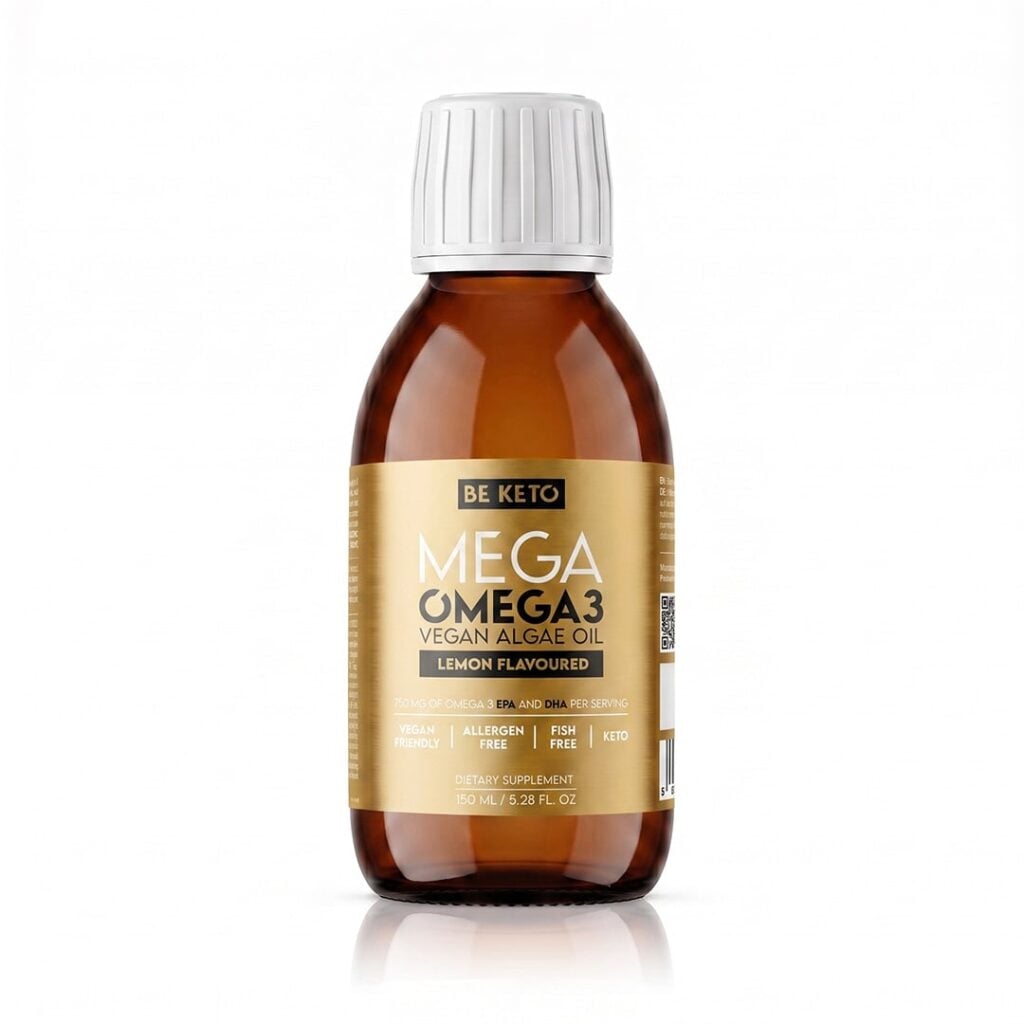
How does BeKeto MEGA Omega score on these criteria? For dose, source and diet fit, MEGA Omega 3 vegan algae oil comes out best for fish-free or vegan keto eaters, because a 5 ml teaspoon provides 570 mg DHA and 185 mg EPA, above SACN’s 450 mg, from Schizochytrium microalgae. [18] [19] For freshness, the manufacturer states that the algal oil ingredient typically has a TOTOX below 8, compared with GOED’s 26, measured before lemon flavouring, not as the finished flavoured product [18] [5]. The bottle is dark glass, with tocopherol-rich extract and rosemary extract [18]. One serving meets the 250 mg conditions for “EPA and DHA contribute to the normal function of the heart” and “DHA contributes to maintenance of normal brain function” [19]. Do not exceed the recommended 5 ml daily serving. This product is intended for adults. Not for use by children or by women who are pregnant or breastfeeding. If you take anticoagulant medication or are due to have surgery, consult your doctor before use [18].
Checking labels for EPA and DHA per serving?
MEGA Omega 3 Vegan states 570 mg DHA and 185 mg EPA in one 5 ml teaspoon, in a dark glass bottle with 30 servings.
This product is intended for adults. Not for use by children or by women who are pregnant or breastfeeding. If you take anticoagulant medication or are due to have surgery, consult your doctor before use.
Frequently asked questions (FAQ)
Which omega-3 supplement is best for women?
Which omega-3 supplement is best for women? The best omega-3 supplement for women uses the same label criteria. Needs differ in pregnancy and breastfeeding, when EFSA sets an additional 100 to 200 mg DHA a day [6]. The NHS advises avoiding cod liver oil when pregnant or trying for a baby, because of vitamin A [16]. Check that the product is suitable for use in pregnancy.
Which omega-3 supplement is best for cholesterol?
Which omega-3 supplement is best for cholesterol? No omega-3 supplement is best for cholesterol. Omega-3 does not lower total cholesterol; in a meta-analysis of 64 randomised controlled trials, it lowered triglycerides by about 0.10 mmol/L per gram [14]. DHA at 2 g a day or more raised LDL by about 0.19 mmol/L versus placebo in meta-analyses of randomised trials of DHA alone [11]. The triglyceride claim requires 2 g EPA and DHA a day [19].
Is fish oil the same as omega-3?
Is fish oil the same as omega-3? Fish oil is not the same as omega-3. Omega-3s are fatty acids, while fish oil is one source of EPA and DHA. Microalgae and other marine microorganisms make EPA and DHA at the base of the marine food chain, and algal, krill and cod liver oils are other sources [1].
What is the best omega-3 supplement on the market?
What is the best omega-3 supplement on the market? The best omega-3 supplement on the market cannot be chosen from rankings alone. In market tests of best-selling supplements in Turkey, a third of syrups had less EPA and DHA than declared [4]. Compare mg of EPA and DHA, raw material and freshness with table 1.
Which omega-3 supplement is best for inflammation?
Which omega-3 supplement is best for inflammation? No omega-3 supplement is proven best for inflammation. Head-to-head trials found no difference between EPA and DHA for the outcomes studied, while a meta-analysis of 96 trials found the largest cytokine reductions at EPA:DHA ratios below 1.0 and 1 to 3 g a day [12]. The GB Register has no inflammation claim.
Discover more in the BeKeto keto shop
Besides supplements, the shop has keto vitamins, snacks and bread.
A graduate in clinical dietetics whose interests begin, not end, with the word diet. She has written specialist content on nutrition. She is fascinated by contemporary food culture, phytotherapy and the effects of the ketogenic diet on cognitive brain function. She promotes diet therapy and the nutritional treatment of disease.
To provide the best experiences, we use technologies like cookies to store and/or access device information. Consenting to these technologies will allow us to process data such as browsing behaviour or unique IDs on this site. Not consenting or withdrawing consent, may adversely affect certain features and functions.
Functional
Always active
The technical storage or access is strictly necessary for the legitimate purpose of enabling the use of a specific service explicitly requested by the subscriber or user, or for the sole purpose of carrying out the transmission of a communication over an electronic communications network.
Preferences
The technical storage or access is necessary for the legitimate purpose of storing preferences that are not requested by the subscriber or user.
Statistics
The technical storage or access that is used exclusively for statistical purposes.Przechowywanie techniczne lub dostęp, który jest używany wyłącznie do anonimowych celów statystycznych. Bez wezwania do sądu, dobrowolnego podporządkowania się dostawcy usług internetowych lub dodatkowych zapisów od strony trzeciej, informacje przechowywane lub pobierane wyłącznie w tym celu zwykle nie mogą być wykorzystywane do identyfikacji użytkownika.
Marketing
The technical storage or access is required to create user profiles to send advertising, or to track the user on a website or across several websites for similar marketing purposes.


 United KingdomCurrent regionDelivery within the United KingdomCurrency: Pound Sterling (£)
 GermanyDelivery within Germany and AustriaCurrency: Euro (€)
 FranceDelivery within France and BelgiumCurrency: Euro (€)
 ItalyDelivery within ItalyCurrency: Euro (€)
 PolandDelivery within Poland and EuropeCurrency: Zloty (PLN)
 Czech RepublicDelivery within the Czech Republic and SlovakiaCurrency: Czech Koruna (Kč)
 SpainDelivery within SpainCurrency: Euro (€)