Krill oil: what it is, its benefits and risks, and krill vs fish oil
Krill oil is an omega-3 supplement extracted from Antarctic krill, which are small crustaceans, not fish. It supplies EPA and DHA, partly bound to phospholipids, and its red colour comes from astaxanthin. Its benefits are those of EPA and DHA at a dose, from 250 mg a day for the heart claim. Avoid krill oil with a shellfish allergy; in a keto shop, algal oil gives EPA and DHA without fish or krill.
Passionate about writing and a graduate in clinical dietetics. She is particularly interested in phytotherapy and the effects of ketogenic nutrition on cognitive brain function.
What is krill oil? It is oil extracted from Antarctic krill, small shrimp-like crustaceans, and sold as an omega-3 supplement. Krill oil contains EPA and DHA, the long-chain omega-3 fats also found in oily fish, and some of these are bound to phospholipids rather than triglycerides. Its red colour comes from astaxanthin, so “red krill oil” is the same product, not a stronger category.
Krill do not make EPA and DHA from scratch. EPA and DHA are made at the base of the marine food chain by microalgae and other marine microorganisms, while fish obtain them mainly from their diet and can synthesise them only to a limited, species-dependent extent [1]. That is the useful context for comparing krill oil supplements with fish oil or algal oil.
What are the benefits of krill oil?
What are the benefits of krill oil? They are the benefits of the EPA and DHA it contains, when taken in sufficient amounts. GB law allows this wording: “EPA and DHA contribute to the normal function of the heart.” The condition is 250 mg EPA and DHA a day [15]. GB law also allows: “DHA contributes to maintenance of normal brain function.” The condition is 250 mg DHA a day [15].
Triglycerides fall by about 0.10 mmol/L per gram of omega-3 from fish oil, a figure reported in a meta-analysis of 64 randomised controlled trials [7]. Across 40 trials of EPA and DHA involving 135,267 people, heart attacks fell by about 13% (RR 0.87), but total cardiovascular events were not significantly reduced (RR 0.95); the meta-analysis was funded by GOED, the omega-3 industry body, and the lead author was a GOED employee [8]. For the wider picture, see omega-3 benefits.
Did you know? The Cochrane review rates the depression evidence for omega-3 as insufficient, with any effect linked to EPA-predominant products (EPA 60% or more).
Krill oil vs fish oil: which is better?
Krill oil vs fish oil: which is better? Neither is better for omega-3s as such, because both deliver EPA and DHA. The deciding factor is the mg of EPA and DHA per daily serving on the label, not the total amount of oil in the capsules.
Fish oil has the larger omega-3 fish oil trial base: VITAL gave 1 g of fish oil a day to 25,871 adults in the US for 5.3 years [9]. For fish oil forms, a study in 72 volunteers taking about 3.3 g of EPA plus DHA a day for 2 weeks found short-term absorption differences versus natural fish oil: re-esterified triglycerides 124%, free fatty acids 91% and ethyl esters 73%; those differences largely disappear with long-term use [6]. Compare krill and fish oil only at the same EPA and DHA dose.
Attribute
Krill oil
Fish oil
Source
Antarctic krill (crustacean)
whole oily fish
Omega-3 carrier form
partly phospholipids
triglycerides or ethyl esters
Red pigment astaxanthin
yes
no
Contains vitamins A and D
check the label
no
Allergy warning
shellfish
fish
Largest trial in our sources
none cited here
VITAL, 25871 adults, 1 g a day
What to compare
mg EPA plus DHA per serving
mg EPA plus DHA per serving
What are the dangers of krill oil?
What are the dangers of krill oil? The main ones are shellfish allergy and the dose-related cautions that apply to omega-3 supplements. Krill are crustaceans, so anyone with a shellfish allergy should avoid krill oil.
In 8 trials with 83,112 people, omega-3 was linked to more atrial fibrillation, about 12% at up to 1 g a day (RR 1.12) and about 51% above 1 g a day (RR 1.51), mainly in people with heart disease or at high risk [10]. In 11 trials with 120,643 people, omega-3 did not increase bleeding (rate ratio 1.09, not significant) [11]. Read more on omega-3 side effects. Ask your GP if you take anticoagulants. EPA plus DHA at 2 to 6 g a day raised LDL cholesterol by about 3% [5].
Did you know? TOTOX equals 2 × peroxide value + p-anisidine value; GOED’s voluntary industry monograph sets maximums of PV 5 meq/kg, p-AV 20 and TOTOX 26, all three at once, as an industry standard, not law.
How much krill oil should you take a day?
How much krill oil should you take a day? It depends on its EPA and DHA content, not on the amount of krill oil printed on the front of the pack. Use the UK SACN population guideline as context: two portions of fish a week, one white and one oily, contain about 450 mg long-chain omega-3 a day [13]. For practical label checks, see how much omega-3 per day. EFSA’s adequate intake is 250 mg EPA plus DHA a day for adults [4].
EFSA saw no safety concerns for supplemental EPA and DHA combined up to 5 g a day in adults, which is not a recommendation [5]. No time-of-day effect has been reported [12]. Take omega-3 with a meal containing fat [6]. For keto supplements, the same rule applies: read the EPA and DHA line, not just the capsule size.
Reference
EPA plus DHA [mg/day]
Type
GB heart claim condition
250
claim condition
EFSA adequate intake
250
European reference
SACN guideline
450
UK population guideline
GB triglyceride claim condition
2000
claim condition
GB blood pressure claim condition
3000
claim condition
EFSA, no safety concerns up to
5000
safety level, not a recommendation
Building a daily supplement routine?
Krill oil labels list EPA and DHA; vitamins come as separate products. Browse keto vitamins in drops and capsules in the BeKeto shop.
Is there an omega-3 without krill or fish, and how does BeKeto MEGA Omega compare?
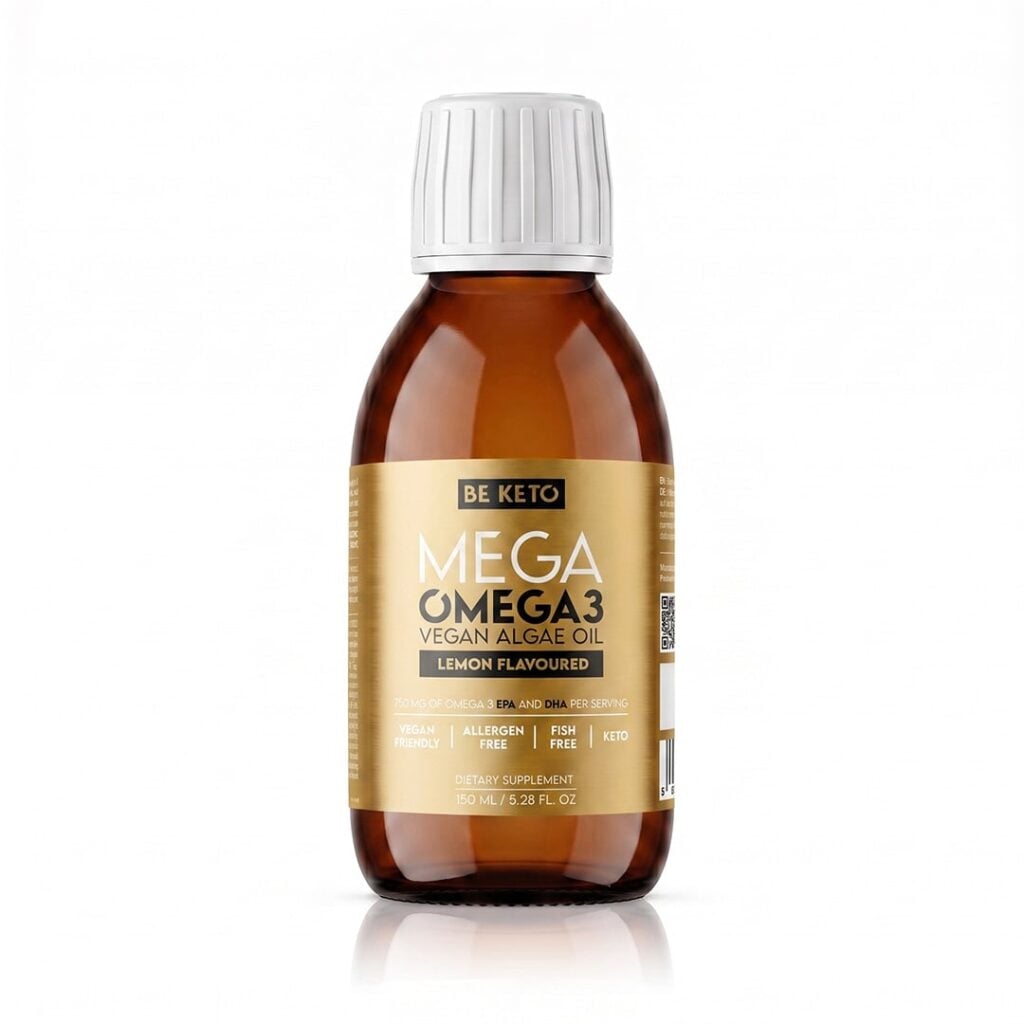
Is there an omega-3 without krill or fish, and how does BeKeto MEGA Omega compare? For anyone with a shellfish allergy or avoiding marine animals, BeKeto MEGA Omega comes out best for keto readers who want an omega-3 without fish or krill because it is fish-free, vegan and free from allergens requiring declaration, while still providing 570 mg DHA and 185 mg EPA per 5 ml serving [14]. The oil comes from Schizochytrium sp. microalgae and is protected with tocopherol-rich extract and rosemary extract [14]. For more background, read our guide to vegan omega-3.
One 5 ml teaspoon of the lemon-flavoured liquid MEGA Omega 3 vegan algae oil gives 570 mg DHA and 185 mg EPA [14]. That is above the SACN 450 mg long-chain omega-3 guideline [13]. It is a fish-free, vegan option for keto readers comparing omega-3 supplements by EPA and DHA per serving [14]. “This product is intended for adults. Not for use by children or by women who are pregnant or breastfeeding. If you take anticoagulant medication or are due to have surgery, consult your doctor before use.” [14]
Looking for an alternative without krill?
Algae oil does not come from marine animals. MEGA Omega 3 Vegan is a lemon-flavoured liquid oil with 570 mg DHA and 185 mg EPA in 5 ml.
This product is intended for adults. Not for use by children or by women who are pregnant or breastfeeding. If you take anticoagulant medication or are due to have surgery, consult your doctor before use.
Frequently asked questions (FAQ)
Is krill oil from fish?
Is krill oil from fish? No: krill are small crustaceans living mainly in Antarctic waters. Like fish, they take in EPA and DHA from the microalgae they eat [1]. That is why krill oil carries a shellfish, not a fish, allergy warning.
Krill oil vs cod liver oil: what is the difference?
Krill oil vs cod liver oil: what is the difference? The difference is mainly vitamins. Cod liver oil contains vitamins A and D as well as EPA and DHA, so EFSA’s adult upper limits of 100 µg vitamin D and 3,000 µg RE vitamin A a day apply [2]. Krill oil comes from crustaceans, cod liver oil from fish.
Who should not take krill oil?
Who should not take krill oil? Anyone with a shellfish allergy should avoid it. Ask your GP first if you take anticoagulants or have heart rhythm problems, since atrial fibrillation rose with omega-3 doses above 1 g a day, mainly in people with heart disease or at high risk [10]. Also ask if you are pregnant or breastfeeding.
Is krill oil good on keto?
Is krill oil good on keto? It fits keto as a fat-based supplement, but we found no human trials of omega-3 supplementation in adults on a ketogenic diet [3]. Whether you need it depends on food choice, including oily fish versus meat, dairy, nuts and plant oils.
When is the best time to take krill oil?
When is the best time to take krill oil? Take it with a meal that contains fat [6]. No time-of-day effect on omega-3 levels has been reported; in 20 people taking fish oil for 8 weeks, omega-3 levels rose over weeks, not days [12].
Discover more in the BeKeto keto shop
Besides supplements, the shop has keto vitamins, snacks and bread.
A graduate in clinical dietetics whose interests begin, not end, with the word diet. She has written specialist content on nutrition. She is fascinated by contemporary food culture, phytotherapy and the effects of the ketogenic diet on cognitive brain function. She promotes diet therapy and the nutritional treatment of disease.
To provide the best experiences, we use technologies like cookies to store and/or access device information. Consenting to these technologies will allow us to process data such as browsing behaviour or unique IDs on this site. Not consenting or withdrawing consent, may adversely affect certain features and functions.
Functional
Always active
The technical storage or access is strictly necessary for the legitimate purpose of enabling the use of a specific service explicitly requested by the subscriber or user, or for the sole purpose of carrying out the transmission of a communication over an electronic communications network.
Preferences
The technical storage or access is necessary for the legitimate purpose of storing preferences that are not requested by the subscriber or user.
Statistics
The technical storage or access that is used exclusively for statistical purposes.Przechowywanie techniczne lub dostęp, który jest używany wyłącznie do anonimowych celów statystycznych. Bez wezwania do sądu, dobrowolnego podporządkowania się dostawcy usług internetowych lub dodatkowych zapisów od strony trzeciej, informacje przechowywane lub pobierane wyłącznie w tym celu zwykle nie mogą być wykorzystywane do identyfikacji użytkownika.
Marketing
The technical storage or access is required to create user profiles to send advertising, or to track the user on a website or across several websites for similar marketing purposes.


 United KingdomCurrent regionDelivery within the United KingdomCurrency: Pound Sterling (£)
 GermanyDelivery within Germany and AustriaCurrency: Euro (€)
 FranceDelivery within France and BelgiumCurrency: Euro (€)
 ItalyDelivery within ItalyCurrency: Euro (€)
 PolandDelivery within Poland and EuropeCurrency: Zloty (PLN)
 Czech RepublicDelivery within the Czech Republic and SlovakiaCurrency: Czech Koruna (Kč)
 SpainDelivery within SpainCurrency: Euro (€)